Revenue Agents and Deal Execution: A Practical Guide
A revenue agent turns deal context into prepared work: drafts, updates and next steps. The useful question is not how autonomous it is, but whether its reasoning is visible and whether people stay in control of what reaches buyers and records.
What a revenue agent should do
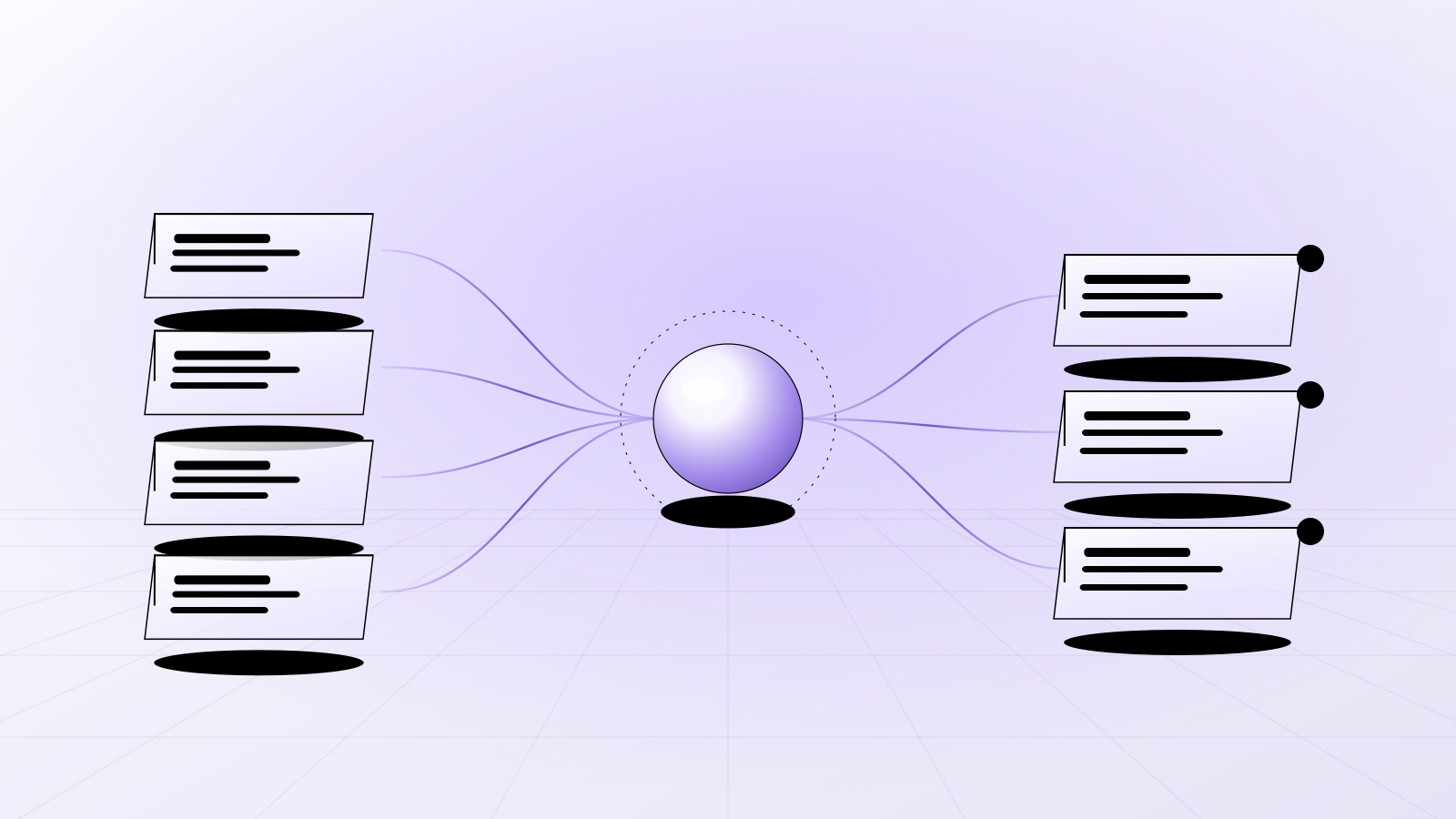
In practice, a revenue agent works through a chain: evidence (conversations, email, CRM context) becomes memory (what is known, by whom, since when), memory supports reasoning (what is at risk, what is missing) and reasoning produces prepared actions (a follow-up draft, a suggested record update, a question for the next call). Each link should be inspectable.
Worked example: from evidence to a prepared action
Evidence. On a call, the buyer's IT lead says the security review starts once the questionnaire arrives. Separately, the champion says finance “should be fine”.
Memory. The agent records the security review as Pending / waiting, with a known process but no completed approval, waiting on the seller's questionnaire, and the finance status as reported by the champion — not confirmed.
Reasoning. The forecast says close this month. The agent flags two open items: a waiting security review with a seller-owned dependency, and a finance approval only reported.
Prepared actions. It drafts a short email to the IT lead attaching the questionnaire, and a suggested question for the champion: “Could your finance lead confirm budget timing on our next call?” It proposes a CRM note but does not change the close date.
Human review. The rep edits the email, sends it, and decides whether to adjust the forecast after speaking with the champion.
Inspect the retrieval-to-action chain
Give a vendor three dated conversations and one opportunity record. Include a champion's finance report, a direct budget decision for a different amount, and a security review waiting on a questionnaire. Ask it to retrieve each source, preserve the contradictory amounts in memory, explain what remains unresolved and prepare only a question that the evidence supports. A quotation proves what someone said; it does not prove that the speaker had authority or that a required review finished.
Next, remove a source or change access. Ask what reasoning is still supported and what becomes unavailable. Reject an action at the review boundary and observe whether anything executes. Then request an export of source pointers, dates, decisions and corrections, and inspect whether another reviewer can reconstruct the reasoning without relying on fluent prose. These are pilot requirements to demonstrate, not claims that any named vendor has or lacks them.
A bounded pilot decision
Agree the consented sample, reviewers and expected interpretation before reviewing outputs. Keep supported, unsupported and not assessable findings separate. Record source-location errors, collapsed contradictions, premature completion and editing effort with the actual denominator. Resolve reviewer disagreements by returning to the source. A useful draft is not an approved buyer action. End with a fit decision and remaining questions, not an extrapolated revenue lift. Use the vendor-neutral rubric and Buyer Approval Check to keep evaluation criteria explicit.
The execution gap
Many deals lose time between knowing and doing: the follow-up that was meant to go out, the reviewer nobody contacted, the question nobody asked. Agents are most useful in that gap — preparing the next step while context is fresh — rather than as a replacement for the seller's judgement.
Human control is a design requirement
Buyer-facing messages are drafted, then reviewed and sent by a person.
Record changes are proposed with their source, then approved.
Forecast judgements stay with the people accountable for them.
Permissions limit what the agent can read and where it can act.
Step-by-step: introducing an agent responsibly
Start with read access and prepared drafts only.
Choose a small set of actions to evaluate (for example, follow-ups and pre-call briefs).
Review every output against its sources for a fixed period.
Expand scope only where reviewers consistently agree with the reasoning.
Document who approves what, and keep an audit trail.
Common failure modes
Drafts that sound confident but cite nothing.
Treating a reported approval as confirmed in a generated summary.
Marking a task complete because a message was sent.
Confusing seller statements with buyer statements in attribution.
Expanding automation before anyone has checked output quality.
Evaluation checklist
Does every prepared action show the evidence it relies on?
Are confirmed, reported, inferred and unresolved items distinguished?
Is a person required to approve buyer-facing messages and record changes?
Is it specific about which systems it connects to and at what access level?
Does it keep context across the deal, not just the last meeting?
Does the vendor avoid unexplained outcome promises?
Can a rejected draft be demonstrated without any buyer message or record change?
Does a deliberately contradictory source remain visible with owner and date?
Can two reviewers distinguish supported actions from unsupported ones on the same pilot sample?
Can the pilot evidence, sources, dates and corrections be exported in a demonstrated usable format?
Does the system preserve source ownership when the CRM refresh replaces a local field edit?
A summary tells you what happened in one meeting. An agent should tell you what it means for the deal — and show its evidence. Here's how to evaluate the difference.